
Drug and alcohol assessments play an important role in maintaining safety, legal compliance, and workplace responsibility across many industries. These assessments help identify substance use issues that may impact a person’s ability to perform duties safely and effectively. In Australia, there are specific circumstances where such assessments are required by law, particularly in safety-sensitive roles, legal proceedings, and rehabilitation programs.
Understanding when these assessments are mandatory is essential for employees, employers, and individuals involved in legal matters. In regions like Campbelltown, services such as Drug and Alcohol Assessments in Campbelltown are commonly used to meet legal and professional obligations.
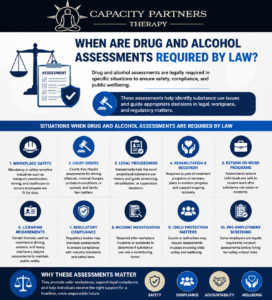
Workplace Safety and Legal Compliance
One of the most common situations where drug and alcohol assessments are legally required is in workplaces that involve high-risk activities. Industries such as transport, construction, mining, and healthcare must comply with strict safety regulations. Employers have a legal duty to ensure that employees are fit for duty and not impaired by drugs or alcohol while working.
Regulatory bodies often require testing and assessments as part of workplace safety programs. These assessments help reduce accidents, protect employees, and ensure compliance with occupational health and safety laws.
Court-Ordered Drug and Alcohol Assessments
Drug and alcohol assessments are also frequently required by the court system. These are typically ordered during legal proceedings involving driving offences, custody disputes, probation conditions, or criminal charges related to substance use.
In such cases, a drug and alcohol assessment for court in Campbelltown may be required to evaluate an individual’s substance use history, current behaviour, and treatment needs. The results are then used by the court to make informed decisions regarding sentencing, rehabilitation, or supervision conditions.
These assessments are conducted by qualified professionals who provide unbiased reports to assist legal authorities in determining appropriate outcomes.
Rehabilitation and Return-to-Work Programs
Another situation where drug and alcohol assessments may be required by law is during rehabilitation or return-to-work programs. Individuals recovering from substance use disorders may be required to undergo assessments to ensure they are fit to safely resume work or other responsibilities.
Employers and healthcare providers often use drug and alcohol assessments in Campbelltown as part of structured recovery and workplace reintegration plans. These assessments help monitor progress and ensure ongoing safety for both the individual and others in the workplace.
Licensing and Regulatory Requirements
Certain professional licences also require drug and alcohol assessments. This is especially common in transport-related roles, such as commercial drivers, aviation staff, and heavy machinery operators. Regulatory authorities may mandate assessments before granting or renewing licences to ensure public safety.
These legal requirements ensure that individuals in safety-critical roles are not impaired while performing duties that could put others at risk.
Drug and alcohol assessments are legally required in several important situations, including workplace safety compliance, court proceedings, rehabilitation programs, and licensing regulations. These assessments play a vital role in protecting individuals, workplaces, and the broader community by ensuring safety and accountability. Understanding when they are required helps individuals and organisations stay compliant and make informed decisions.
Book An Appointment Today
If you require professional and confidential support, Capacity Partners Therapy provides trusted services for Drug and Alcohol Assessments in Campbelltown. Contact Capacity Partners Therapy today to book a comprehensive assessment and ensure full legal and professional compliance.
Call us at 0488 544 885 or email us at info@capacitypartners.com.au for more information.
FAQ
2. When are drug and alcohol assessments required in the workplace?
They are required in high-risk industries such as transport, construction, and mining where safety laws mandate employees be fit for duty and not under the influence while working.
3. Can a court order a drug and alcohol assessment?
Yes. Courts can order assessments during criminal cases, driving offences, custody matters, or probation requirements to evaluate substance use and inform legal decisions.
4. Why do courts require drug and alcohol assessments?
Courts use these assessments to understand a person’s substance use history and determine appropriate sentencing, rehabilitation programs, or supervision conditions.
5. Are drug and alcohol assessments mandatory for all employees?
No, they are only mandatory in specific roles or industries where workplace safety laws require fitness-for-duty evaluations or drug and alcohol policies.
6. Who conducts legally required drug and alcohol assessments?
Qualified health professionals such as psychologists, counsellors, or addiction specialists conduct these assessments to ensure accurate and unbiased reporting.
7. What happens if someone refuses a mandatory assessment?
Refusing a legally required assessment may result in disciplinary action at work, legal penalties, or non-compliance consequences depending on the situation.
8. Are drug and alcohol assessments required for licensing?
Yes, certain professional licences such as commercial driving, aviation, and heavy machinery operation may require assessments to ensure public safety compliance.
9. How often are these assessments required by law?
Frequency depends on the role or legal condition. Some may be one-time court orders, while others are periodic workplace safety requirements.
10. Do rehabilitation programs require drug and alcohol assessments?
Yes, rehabilitation and return-to-work programs often require assessments to monitor progress and ensure individuals are fit to safely resume responsibilities.

